

History • Culture
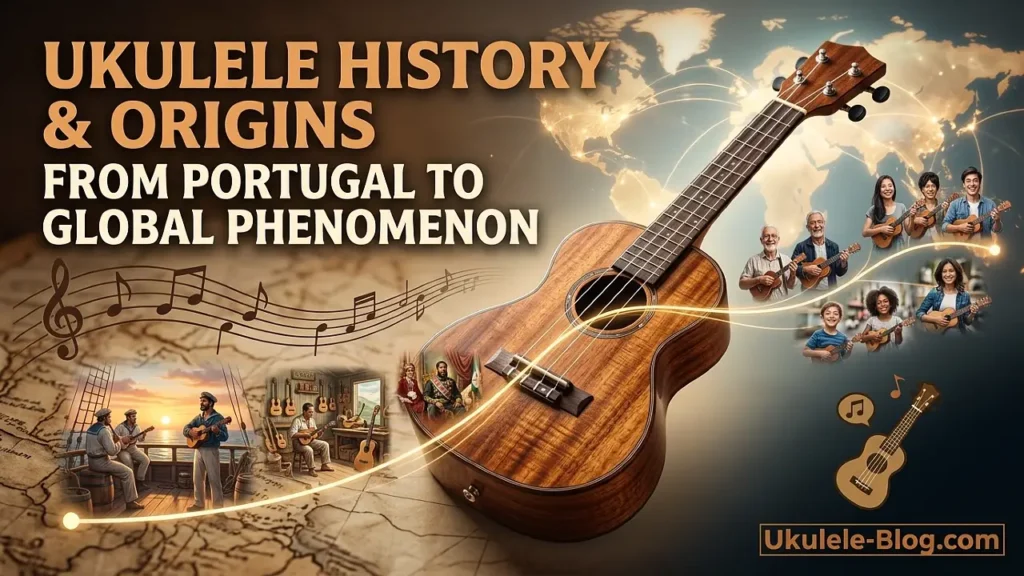
Ukulele History and Origins: From Portugal to Global Phenomenon

A journey of 8,000 miles, three small islands, and one joyful sound.
When you hear the bright, cheerful strum of a ukulele, you probably think of Hawaiian beaches and grass skirts. But the true story of the ukulele is an epic global voyage—a tale of immigration, innovation, and cultural fusion that transformed a small Portuguese folk instrument into a worldwide symbol of joy. The history and origins of the ukulele are richer and more surprising than you might imagine. From the docks of Lisbon to the royal courts of Honolulu, this is the story of how a humble “machete” became the instrument that conquered hearts across continents. Knowing this history doesn’t just fill your mind with facts; it deepens your connection to every chord you play.
The Humble Beginnings: The Portuguese “Machete”
Our story begins not in the Pacific, but in the Atlantic, on the Portuguese archipelago of Madeira. In the 1870s, Portuguese craftsmen were building small, guitar-like instruments known as “machetes” (or braguinhas). These instruments typically had four gut strings and a tuning similar to the top four strings of a guitar (D-G-B-D). They were beloved for their sweet, bright sound and portability.
The Great Migration: In 1879, facing a devastating famine, thousands of Madeirans sought new opportunities across the oceans. A ship named the Ravenscrag embarked on a four-month journey, carrying not only hopeful immigrants but also their music and instruments. When it docked in Honolulu on August 23, 1879, it delivered the raw materials of a musical revolution.
Landing in Hawaiʻi: Birth of the “Jumping Flea”
Among the passengers of the Ravenscrag were three master woodworkers: Manuel Nunes, José do Espírito Santo, and Augusto Dias. Recognizing opportunity, they soon set up shops in Honolulu, crafting furniture and, of course, instruments. They adapted the machete to local Hawaiian woods like koa, which produced a warmer, more resonant sound. The instrument was an instant hit.
Where Did the Name “Ukulele” Come From?
The name itself is a point of delightful debate and is deeply rooted in the Hawaiian language.
The “Jumping Flea” Theory 🦗
The most popular story credits Englishman Edward Purvis, a Vice-Chamberlain to King Kalākaua and a small, sprightly man who was a skilled player. Hawaiians, observing his fast-flying fingers on the fretboard, supposedly called the instrument “ʻukulele”, which translates to “jumping (lele) flea (ʻuku)”.
The “Gift That Came Here” Theory 🎁
Another interpretation comes from Queen Liliʻuokalani, Hawaiʻi’s last monarch. She suggested the name meant “the gift (uku) that came here (lele)”, a beautiful nod to the instrument’s Portuguese origins and its welcome arrival in the islands.
Whichever story is true, the name stuck, perfectly capturing the instrument’s lively, playful character.
The Royal Endorsement: Kalākaua and the Ukulele’s Rise
The single most important factor in the ukulele’s adoption into Hawaiian culture was the patronage of King David Kalākaua (1836-1891), known as the “Merrie Monarch.”
King Kalākaua was a passionate patron of the arts and a champion of Hawaiian culture during a time of great foreign influence. He incorporated the ukulele into royal gatherings, state functions, and traditional hula performances. Where the king led, the people followed. The instrument quickly shed its “foreign” label and became a central part of Hawaiian musical identity.
His sister and successor, Queen Liliʻuokalani, was also a prolific composer (“Aloha ʻOe”) and a keen player, further cementing the ukulele’s noble status.
“He nani ka ʻike i ke aliʻi e hoʻokani pila ana.”
“It is beautiful to see the king playing music.”
The 20th Century: Conquering the Mainland and the World
The ukulele’s journey was just beginning. Two major events propelled it onto the global stage.
The Panama-Pacific Exposition
A Hawaiian pavilion at this world’s fair in San Francisco introduced mainland Americans to the ukulele and the sweet sound of Hawaiian music. It sparked a massive fad, a true “Ukulele Craze.”
The Jazz Age & Tin Pan Alley
The ukulele became a staple of vaudeville and jazz age society. Companies like Martin began manufacturing high-quality ukes on the mainland. It was cheap, cheerful, and easy to learn—the perfect parlor instrument. Everyone from housewives to college students had one.
TV & The “Plastic Uke”
Arthur Godfrey, a hugely popular TV personality, gave ukulele lessons on his show, selling millions of plastic “TV Pal” ukes. Artists like Tiny Tim (“Tiptoe Through the Tulips”) cemented its place in pop culture, albeit with a more quirky, novelty image.
The Modern Renaissance: From Novelty to Serious Instrument
By the late 20th century, the ukulele was often seen as a toy. But a series of events sparked a profound revival.
1990s: Israel Kamakawiwo’ole
His medley of “Somewhere Over the Rainbow/What a Wonderful World,” recorded in 1988 but achieving global fame in the 1990s, is the most important ukulele recording of all time. Iz’s soulful, heartfelt performance reintroduced the world to the instrument’s profound emotional power, beyond mere novelty.
2000s: The Internet & YouTube
Platforms like YouTube allowed players like Jake Shimabukuro to go viral (his “While My Guitar Gently Weeps” cover in 2006 stunned millions). Suddenly, the world saw the ukulele as a vehicle for breathtaking virtuosity. Online communities and tutorials made learning easier than ever.
2010s-Present: Mainstream Pop
Artists like Taylor Swift, Eddie Vedder, and twenty one pilots incorporated the uke into hit songs, making it cool for a new generation. Its portability, affordability, and friendly sound made it the perfect antidote to digital, over-produced music.
The Legacy: More Than Just an Instrument
The ukulele’s history is a mirror of larger cultural stories: immigration and adaptation, the preservation of indigenous culture, and the universal search for joy and connection through music. It represents the Hawaiian spirit of aloha—welcoming, sharing, and finding happiness in simplicity.
When you play, you are part of this unbroken chain that stretches from a Madeiran woodshop to a Hawaiian palace, from a Tin Pan Alley stage to a viral YouTube video. To learn about the modern masters carrying this legacy forward, explore our list of famous ukulele players.
A Story Still Being Written
The history and origins of the ukulele teach us that great cultural contributions often come from unexpected places and humble beginnings. It is an instrument born of necessity, nurtured by royalty, popularized by media, and reborn through artistry. Its journey from a Portuguese machete to a global phenomenon is a testament to music’s power to cross oceans, bridge cultures, and bring simple joy to millions.
Every time you pick up your uke, you are not just making music—you are adding a note to this ongoing, beautiful story.
What does the ukulele mean to you? Did any part of this history surprise you? Share your thoughts and keep the conversation going in the comments below. If you enjoyed this journey through time, please share it with a fellow music lover.